Back to learning center
Enterprise AI agents vs. RPA: key differences and when to use each


Enterprise AI agents and RPA (robotic process automation) both automate business workflows – but they are built for fundamentally different problem types. RPA excels at structured, rule-based tasks with predictable data. Enterprise AI agents handle unstructured documents, reasoning-driven workflows, and dynamic exceptions that RPA cannot process reliably.
RPA has delivered real results for enterprises over the past decade. For structured, predictable workflows like copying data between systems, processing fixed-format files, and triggering rule-based actions, it worked exactly as promised.
However, finance and operations teams are now hitting a hard ceiling. The processes that consume the most analyst time – invoice reconciliation, remittance matching, contract review, exception handling – are document-heavy, variably formatted, and require contextual judgment. These are exactly the workloads RPA was not designed for, and they represent the highest-value automation opportunities in the back office.
The question facing enterprise leaders in 2026 is not whether to use AI agents vs. RPA. It is understanding which problem class each technology solves and building an intelligent automation strategy that deploys the right tool for the right workflow.
This article breaks down where RPA excels, where its RPA limitations create fragility, and how agentic AI excels at handling the unstructured, exception-driven work that defines modern back-office operations. The two technologies are complements, not competitors. Understanding the difference is the key to automation that scales.
Robotic process automation (RPA) automates repetitive, rule-based tasks by scripting interactions with software interfaces. It mimics how a human would click through a system – navigating screens, copying fields, triggering actions – at machine speed across thousands of transactions.
Where does RPA excel?
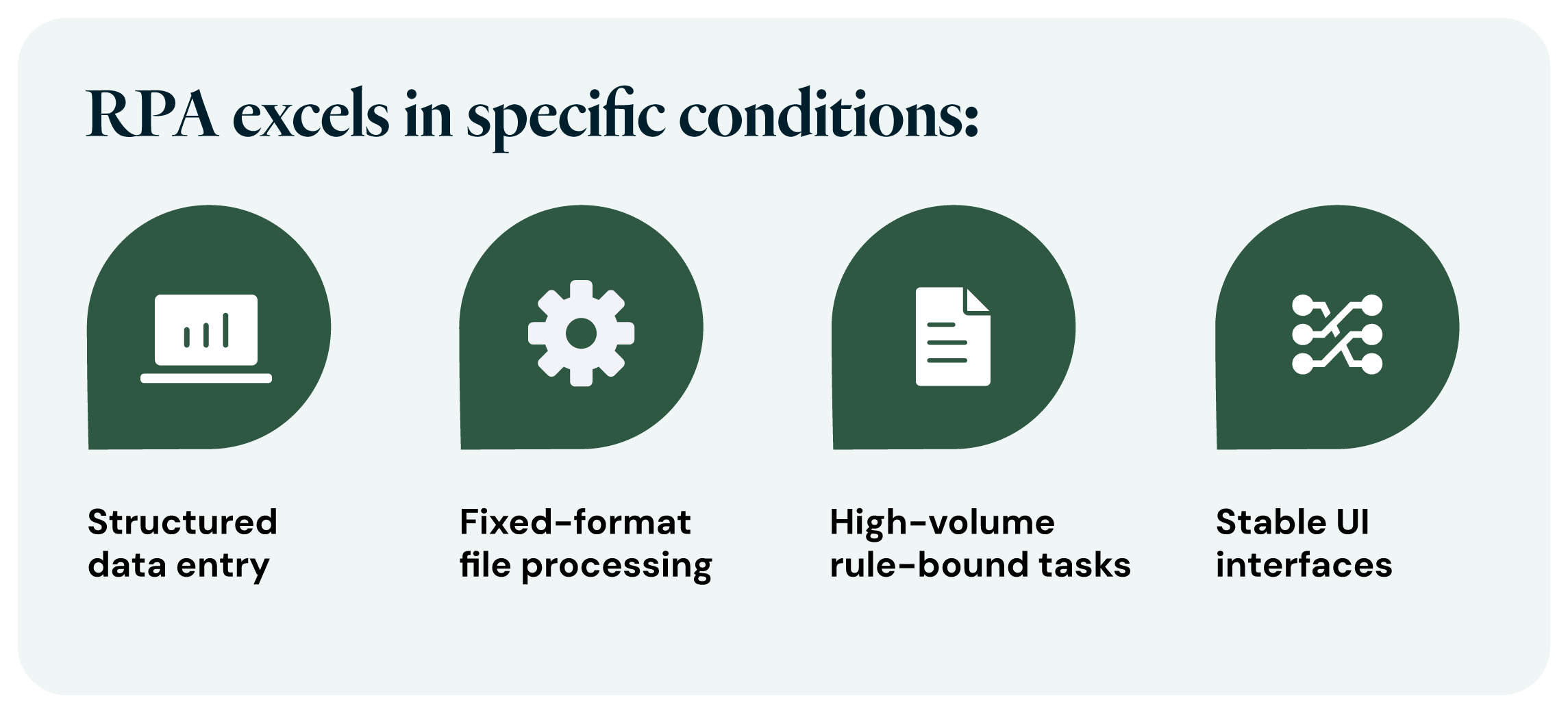
RPA’s design assumption is straightforward: the world is structured, predictable, and consistent. The automation script works perfectly when this assumption holds.
The assumption breaks when it encounters unstructured documents, variable formats, dynamic exceptions, and workflows that require reasoning about meaning rather than pattern-matching on data. This is not a flaw in RPA. It is a boundary condition of the technology’s architecture. Understanding where that boundary falls is essential for any enterprise AI agent platform evaluation.
The limitations of RPA become visible the moment workflows involve variability. Here is how that fragility manifests in practice.
The brittle RPA problem. RPA scripts are written for specific data layouts and field positions. When a vendor changes their invoice format, when a customer sends remittance via email instead of PDF, or when a new exception type appears that was not in the original script, the automation fails. Every variation requires a developer to write a new rule branch.
Unstructured document reality. In B2B finance, remittance advice arrives as multi-page PDFs, emails with payment details buried in body text, and spreadsheets formatted differently by every customer. There is no consistent layout to template. Historically, RPA systems cannot read complex and varying documents reliably as they have been designed for pre-structured, predictable inputs.
Process variability compounds the problem. Even when the document is readable, the process logic varies: this customer always short-pays, that vendor uses non-standard PO numbers, this invoice has a pricing dispute attached. RPA has no way to reason about these variations – it either errors out or routes everything to a human queue.
Maintenance cost escalation. As business processes evolve – new vendors, new ERP versions, new document formats – RPA maintenance costs compound. Enterprises with mature RPA programs often find that the biggest share of the total cost of ownership is dedicated to maintaining and repairing existing scripts rather than building new automations.
A concrete example. Consider an AR team processing 5,000 remittance documents monthly. Their RPA bot handles 20% – the ones that arrive in the exact expected PDF format from their top three customers. The other 80% pile up in the exception queue, waiting for analysts to manually match payments to invoices. The bot works. It just cannot manage the work that matters most.
Enterprise AI agents are architecturally different from RPA. They are designed for exactly the problem classes where scripts break down.
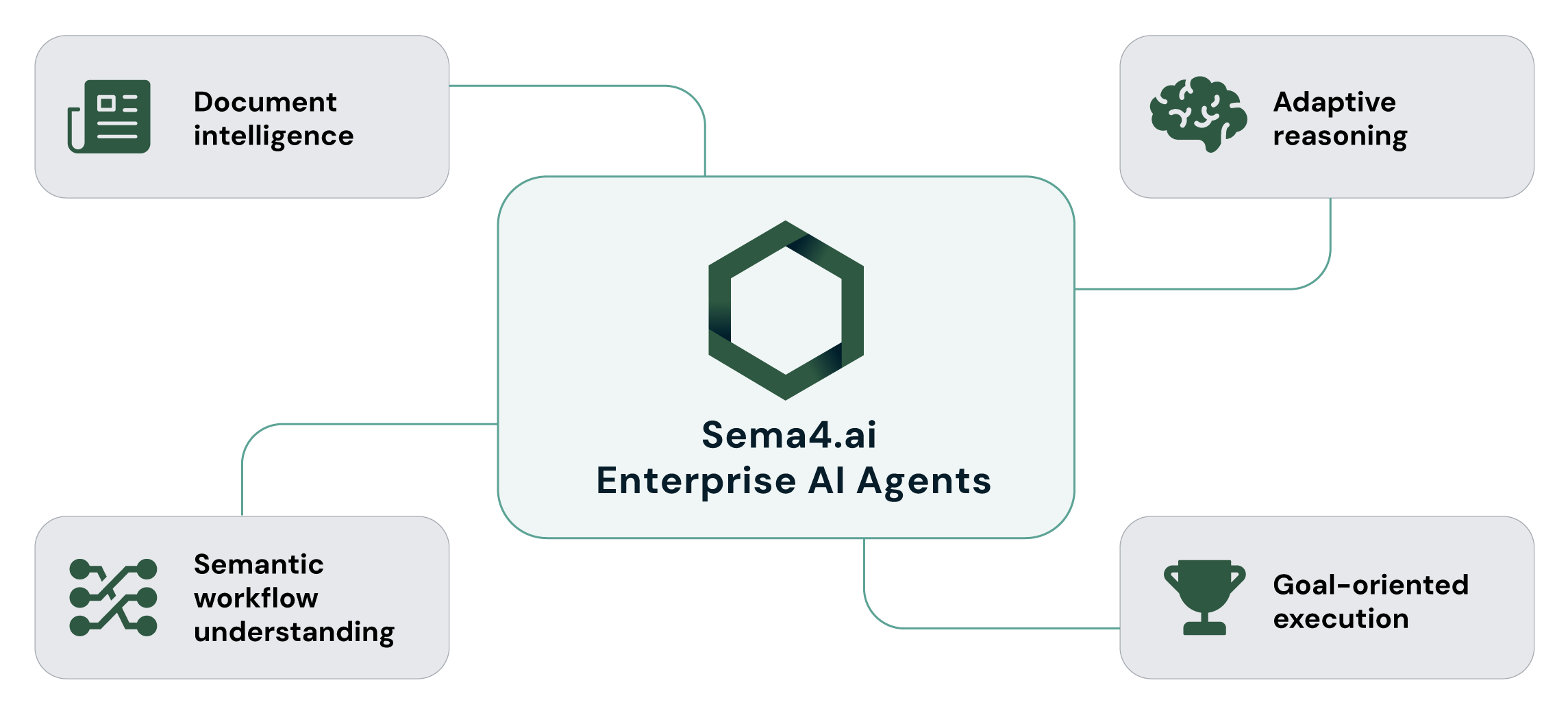
Document intelligence. AI agents read and interpret unstructured documents the way a human analyst would, extracting line-item data from a remittance PDF regardless of its layout, understanding that “INV#” and “Invoice Number” refer to the same field, and contextualizing partial information against open records in the ERP. No templates. No fixed field positions. The agent adapts to whatever format arrives.
Adaptive reasoning. When an AI agent encounters an exception like a short-pay, a missing invoice number, or a disputed line item, it reasons about the context rather than failing. It checks the customer’s payment history, reviews the contract terms, identifies the most likely resolution, and either resolves it automatically or escalates with a complete recommendation.
Semantic workflow understanding. AI agents are grounded in a semantic data layer that maps natural language to verified business concepts. The agent understands what “days sales outstanding” means in the context of this organization’s chart of accounts, not just where the field appears in the data. This semantic grounding prevents hallucinated calculations and ensures consistent, auditable results.
Goal-oriented execution. Unlike RPA, which executes a fixed sequence of steps, AI agents reason toward a defined goal, such as “match this payment to its open invoices”. Agents select tools and adjust approach based on what each step returns. If one approach fails, the agent tries another before escalating.
The architectural answer that makes this reliable at enterprise scale: LLMs handle document understanding and agentic reasoning. SQL-powered DataFrames handle matching and calculations with deterministic accuracy. AI is used to read, interpret, and reason. Math is handled by code. Every step and result is tracked and auditable.
How a system handles exceptions defines whether it can be trusted in regulated, high-stakes environments. RPA and AI agents take fundamentally different approaches.
RPA and escalation. Certain RPA workflows route work to people by design when an issue arises. High-stakes decisions are often deliberately built in as approval steps, and most modern platforms provide task and activity views that give reviewers context on what the bot did and where it stopped. The gap shows up when exceptions occur that the workflow was never designed for. There, the available context is execution-level, showing which step failed and what the inputs were, rather than judgment-level. The person still has to go back to the source document, work out what the process should have done, and decide how to resolve it before the bot can pick the task back up.
AI agents and HITL. When an AI agent reaches a genuine decision point it cannot resolve autonomously, such as a payment that matches multiple open invoices, a dispute requiring customer contact, or an approval above a defined threshold, it pauses, assembles all relevant context, and routes the task to a human in the Work Room with a recommended action. The human reviews the recommendation, approves in one click, and the agent resumes and completes the workflow.
Why HITL matters for enterprise deployment. In finance, procurement, and compliance workflows, 100% automation is not the goal. Appropriate automation is. HITL controls define exactly where human judgment is required and ensure agents never act beyond their authorized scope. This is what makes AI agents safe to deploy in regulated environments where errors carry real consequences.
HITL is not a workaround for insufficient AI. It is a design principle that enables collaborative automation at enterprise scale – humans and agents each doing what they do best.
| Capability | RPA | Enterprise AI agents | Why it matters |
| Unstructured documents | Weak – requires rigid templates and fixed field positions. | Strong – reads and interprets any format using document intelligence. | Remittance PDFs, contracts, and emails arrive in dozens of inconsistent formats. RPA breaks; agents adapt. |
| Adaptive reasoning | No – follows fixed rule trees; cannot reason about exceptions. | Yes – evaluates context, infers intent, and selects the appropriate action dynamically. | Real workflows have edge cases. Agents handle them; RPA escalates everything it was not programmed for. |
| Human escalation (HITL) | Limited – typically fails or stops; requires manual restart. | Native – agents pause, route to a human with full context, and resume post-approval. | HITL is a feature, not a failure mode. Agents are designed to collaborate with humans at defined decision points. |
| Dynamic workflows | Weak – brittle when process steps, UI layouts, or data formats change. | Strong – reasons across variable process paths and adapts to system or format changes. | Enterprise workflows evolve. Agents tolerate change; RPA maintenance costs compound with every update. |
| Process variability | Low tolerance – each variation requires a new script or rule branch. | High tolerance – handles variability through contextual reasoning rather than hardcoded rules. | No two vendor invoices or customer remittances are identical. Agents handle the variance; RPA cannot. |
| Semantic workflow understanding | None – operates on surface-level data patterns, not business meaning. | Yes – grounded in a semantic data layer that understands business context, terms, and intent. | Understanding what a field means – not just where it appears – is what separates automation from intelligence. |
| Document-heavy workflows | Weak – requires pre-structured data or OCR templates for each document type. | Strong – document intelligence extracts and contextualizes data from any unstructured source. | Finance, procurement, and legal workflows are document-heavy by nature. Agents are designed for this; RPA is not. |
| Goal-oriented execution | No – task-oriented; executes a predefined sequence of steps regardless of outcome. | Yes – reasons toward a defined goal, selecting tools and adjusting approach based on results. | Goal-orientation is what enables agents to complete multi-step workflows end-to-end without constant human instruction. |
Finance and operations teams hitting the limits of RPA on document-heavy, exception-driven workflows are moving to enterprise AI agents. Learn how Sema4.ai handles unstructured remittance documents, invoice reconciliation, and procurement workflows that RPA cannot process reliably.
See how Sema4.ai automates document-heavy back-office workflows
Choosing between RPA and AI agents is not a technology ranking, it is a workflow fit decision. The right tool depends on the characteristics of the work.
| Workflow type | Better fit: RPA | Better fit: AI agents |
| Invoice processing | Structured ERP entry from fixed-format files. | Unstructured remittance PDFs, email-based payment detail, multi-format vendor invoices. |
| Data entry and migration | Copying structured data between systems with known field mappings. | Extracting and normalizing data from documents, emails, and mixed sources. |
| Exception handling | Simple yes/no rule branches with known exception types. | Dynamic exceptions requiring contextual reasoning, research, and HITL escalation. |
| Report generation | Fixed-format reports from structured data sources. | Variance commentary, narrative generation, and multi-source synthesis. |
| Multi-system workflows | Linear sequences with stable system interfaces. | Workflows spanning ERP, CRM, banking APIs, and documents with dynamic routing. |
| Compliance and audit | Logging structured process steps for known audit trails. | End-to-end reasoning traces, explainable decisions, and adaptive governance controls. |
The most effective enterprise automation strategies are hybrid. RPA handles structured back-end processes – data entry, file transfers, fixed-format report generation – where it has always excelled. AI agents handle the document-heavy, exception-driven, and reasoning-required workflows that sit upstream. The two technologies complement each other rather than compete.
The decision framework is straightforward: if the workflow involves predictable data, fixed steps, and stable interfaces, RPA is likely the right tool. If it involves unstructured documents, process variability, contextual judgment, or high exception rates, enterprise AI agents are purpose-built for that problem class.
Sema4.ai is the enterprise AI agent platform built for the document-heavy, reasoning-driven back-office workflows where RPA reaches its limits.
For companies looking to explore how to automate advanced business processes via an enterprise AI agent platform and work in a complementary way with RPA tasks, let Sema4.ai show you how to improve outcome speed and accuracy, while lowering costs and risk.
What is the difference between AI agents and RPA?
RPA automates structured, rule-based tasks by scripting software interactions – it works when data is predictable and process steps are fixed. Enterprise AI agents handle unstructured documents, process variability, and reasoning-driven workflows. The core difference: RPA follows scripts; AI agents reason toward goals using contextual understanding of business meaning.
Why does RPA break on unstructured data?
RPA scripts are written for specific data layouts and field positions. When a vendor invoice arrives in an unexpected format, when a remittance document contains ambiguous fields, or when an exception type was not anticipated in the original script, the automation fails. Every variation requires a developer to write a new rule branch – costs that compound over time.
How do AI agents handle ambiguity in business workflows?
AI agents use contextual reasoning – not rigid rule trees – to evaluate ambiguous inputs. When a payment partially matches multiple invoices, the agent reviews payment history, contract terms, and customer context to determine the most likely resolution. If it cannot resolve with sufficient confidence, it escalates to a human with a complete recommendation rather than failing silently.
What is HITL escalation in AI agent automation?
Human-in-the-loop (HITL) escalation is a defined design pattern where an AI agent pauses at a specific decision point and routes the task to a human for review. Unlike RPA systems, AI agents are more flexible, leveraging advanced LLMs, and are designed to present the human with full context and a recommended action, enabling one-click approval before the agent resumes.
What are document-heavy workflows and why can’t RPA handle them?
Document-heavy workflows involve processing unstructured inputs – remittance PDFs, vendor invoices, contracts, email-based payment details – where data arrives in inconsistent formats from multiple sources. RPA requires pre-structured, templated inputs and fixed field positions. AI agents read and interpret documents in any format using document intelligence, the way a human analyst would.
What is adaptive automation?
Adaptive automation refers to systems that adjust their behavior based on context, outcomes, and changing conditions – rather than following a fixed script. Enterprise AI agents are adaptive: they select tools dynamically, adjust their approach based on what each step returns, and learn from human corrections over time. RPA is not adaptive. Every variation requires a code change.
When should an enterprise replace RPA with AI agents?
Consider AI agents when workflows involve unstructured documents, high exception rates, variable process paths, or requirements for contextual reasoning. RPA remains the right tool for high-volume structured processes with stable data formats and predictable steps. Most enterprises benefit from a hybrid strategy – RPA for structured back-end tasks, AI agents for document-heavy and reasoning-driven workflows upstream.
What are semantic workflows?
Semantic workflows are automated processes grounded in a business meaning layer. The system understands what data means, not just where it appears. Enterprise AI agents use a semantic data layer to interpret terms, metrics, and relationships in the context of the organization’s specific business logic, preventing calculation errors and enabling consistent, auditable results across variable inputs.
See how Sema4.ai automates financial use cases like accounts receivable matching, invoice reconciliation, and procurement workflows – with native HITL escalation and full auditability.
Current RPA users looking to move to agents should begin by looking at their automation backlog. Identify high-value, high-volume processes and workflows that have been lingering at the top of the priority list, but have never made it to implementation because of factors described in this article, like unstructured data and decision points that route to a human for execution, without recommended actions.
Learn more about the Sema4.ai platform for building AI agents that adapt to process variability and handle unstructured data. Sema4.ai Agents are configured in plain English by your operations team, with no engineering overhead.

 Learn about Agent Studio