Back to learning center
What are enterprise AI agents? A comprehensive guide

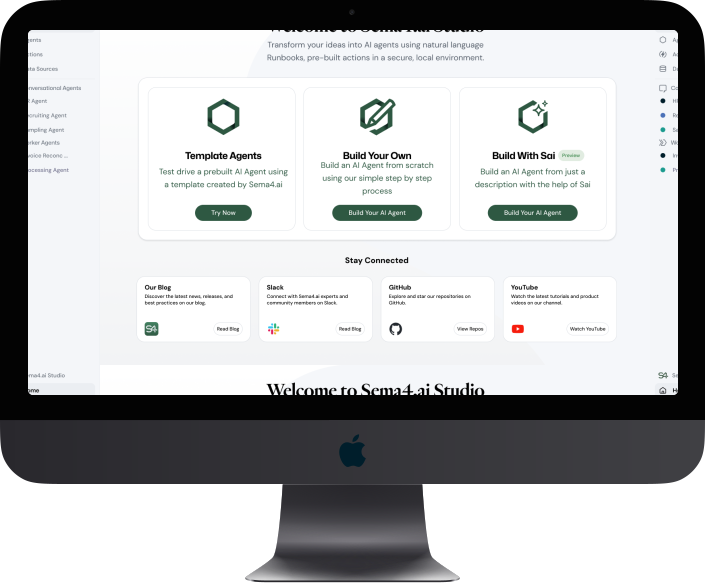
Enterprise AI agents are autonomous, LLM-powered software systems designed to perceive their environment, reason through complex business logic, and execute multi-step workflows. Unlike traditional RPA or basic copilots, enterprise AI agents independently manage tasks across enterprise systems, leveraging natural language processing and agentic orchestration to achieve specific organizational goals without constant human intervention.
The enterprise technology landscape is experiencing significant changes as organizations move from traditional chatbots copilots and Robotic Process Automation (RPA) towards more advanced enterprise AI agents. These autonomous, goal-oriented systems take intelligent automation further through reasoning, planning, and executing complex workflows with minimal human input.
Unlike previous technologies, enterprise AI agents act as independent decision-makers that can perceive their environment, retain memory of past interactions, and take purposeful actions to meet specific business objectives. This shift is reshaping workflow automation and driving improved operational efficiency. For AI solution architects, enterprise IT leaders, and innovation teams, understanding the capabilities and deployment strategies of enterprise AI agents is now important for maintaining a competitive position. This comprehensive guide examines what enterprise AI agents are, how they differ from existing automation tools, and introduces Sema4.ai’s SAFE deployment framework for the scalable and secure orchestration of agents within complex enterprise systems.
Enterprise AI agents are sophisticated software systems, specifically designed for business environments, that operate with a high degree of autonomy. Powered by advanced large language models (LLMs), these agents go beyond traditional automation tools and basic AI assistants by independently comprehending their surroundings, tackling complex challenges, and retaining information for future application. They are capable of executing tasks to meet specific business objectives without the need for constant human oversight.
LLM-powered enterprise AI agents operate with skilled-worker-level autonomy by leveraging agentic workflows and Generative AI. This means they can make informed decisions and adapt to changes without requiring detailed step-by-step instructions. These agents integrate into enterprise workflows to drive efficiency and decision-making three core capabilities:

This approach represents a shift from reactive copilots, which require user prompts, to proactive agents that can initiate actions based on environmental triggers, business rules, or set goals. While copilots assist users in completing tasks, enterprise AI agents can independently manage entire workflows, adapt to changing conditions, and enhance their performance through continuous learning. In practical applications, a copilot might assist a user in writing an email, whereas an enterprise AI agent can oversee customer communications, identify issues that need escalation, draft suitable responses, route them through approval processes, and track resolution outcomes—all without human intervention unless exception handling is necessary.
Enterprise AI agents function through a continuous loop of perception, reasoning, and action.
1. Perception: The agent monitors its designated environment, collecting information from various sources including databases, APIs, sensor data, and user interactions.
2. Reasoning and planning: Following perception, the agent engages in reasoning and planning. Using its built-in intelligence, the agent analyzes the collected data against its knowledge base and predefined objectives. It identifies patterns, evaluates potential actions, and formulates a strategic plan to achieve its goals. This planning phase considers available resources, constraints, and potential risks. Based on the planned approach, it chooses the most suitable methods for task execution, whether that involves calling specific APIs, accessing databases, or triggering other automated processes.
3. Action and execution: Finally, the agent executes the planned actions, monitoring the results and adjusting its approach as needed.
For example, when handling an IT support ticket, an enterprise AI agent first perceives the incoming request by analyzing the ticket description, priority level, and user information. It then reasons through potential solutions by consulting its knowledge base and checking system status. The agent selects appropriate diagnostic tools and APIs to investigate the issue, executes troubleshooting steps, and if successful, automatically resolves the ticket while updating all relevant systems and notifying the user of the resolution.
Enterprise automation with AI agents is transforming how businesses operate, emphasizing the need for cost reduction, expedited decision-making, and consistent global service delivery. Traditional automation often falls short due to the substantial manual input required and its inflexibility to adapt to changing business needs. Intelligent automation, powered by enterprise AI agents, overcomes these limitations by managing complex, multi-step processes with minimal human intervention.
Enterprise AI agents reduce cost, accelerate insights, and bring consistency to global operations. Cost savings are realized through automation, decision-making is accelerated with real-time data insights, and consistency in managing complex workflows is enhanced. For example, healthcare organizations report a 40-60% reduction in administrative processing times when using AI agents for patient scheduling and insurance verification.
By replicating the decision-making processes of skilled professionals, these agents ensure consistent service quality irrespective of geography. As businesses expand, maintaining high standards across diverse markets becomes increasingly crucial. Focusing on these tangible outcomes highlights the importance and benefits of embedding intelligent automation within enterprise operations.
In the enterprise world, various types of AI agents play essential roles in enhancing efficiency and decision-making.
Enterprises also explore using copilots and autonomous agents, though the distinction is significant. Copilots assist and enhance human capabilities by offering suggestions, while autonomous agents independently execute tasks within defined parameters.
For a more detailed exploration of AI agent types and their applications, refer to our comprehensive guide on this subject.
AI agent orchestration is the process of coordinating and managing multiple specialized AI agents to work together toward achieving larger business objectives. Rather than deploying isolated agents that operate independently, multi-agent orchestration creates a unified system where agents communicate, share information, and coordinate their activities to complete complex, multi-step business processes.
The importance of AI agent orchestration becomes clear when considering enterprise-scale deployments. Individual agents may excel at specific tasks, but orchestration ensures agents work in sync to complete multi-step workflows. For example, a customer onboarding process might involve agents specialized in document verification, system provisioning, compliance checking, and communication management—all working in coordinated sequence.
Orchestration platforms manage task delegation, data flow between agents, error handling, and performance monitoring across the entire agent ecosystem. Without proper orchestration, enterprises risk creating fragmented agent deployments that fail to deliver cohesive business value or scale effectively across organizational needs.
Implementing enterprise AI agents introduces several critical challenges that organizations must address to ensure successful deployment. AI governance represents the most significant concern, as autonomous agents make decisions that can impact business operations, customer relationships, and regulatory compliance. Establishing clear governance frameworks ensures agents operate within acceptable parameters while maintaining transparency and accountability.
AI compliance challenges become particularly complex in regulated industries where agents must adhere to specific legal and regulatory requirements. Financial services organizations must ensure their agents comply with banking regulations, while healthcare providers must maintain HIPAA compliance in all agent interactions. These requirements demand sophisticated audit trails, decision logging, and explainability features.
Deploying ethical AI agents across enterprise systems requires major security considerations. Agents require access to sensitive data and systems to function effectively, creating potential vulnerabilities that malicious actors could exploit. Implementing robust security frameworks, including encryption, access controls, and continuous monitoring, becomes essential for protecting organizational assets.
Sema4.ai’s SAFE (Secure, Accurate, Fast, Extensible) framework addresses these risks head-on by governing scale, adaptability, and transparency. This framework enables organizations to realize the benefits of AI agents while maintaining the control and oversight necessary for enterprise-grade deployment.
Building enterprise AI agents that perform reliably and scale with business needs requires deliberate design. Sema4.ai’s SAFE framework lays the foundation, ensuring agents are robust, governable, and aligned with enterprise standards. SAFE agents integrate with internal systems, understand business context, and autonomously execute end-to-end tasks using structured workflows.
Effective design also requires strong security, contextual memory, and real-time feedback. Enterprise AI agents must protect data, retain context, and adapt to changing inputs while staying in lock-step with enterprise goals and requirements.
Sema4.ai helps enterprises build, run, and manage AI agents that do real work across documents, data, and business systems. The platform brings together agent development, enterprise context, secure execution, human collaboration, and operational control—so teams can move beyond isolated AI pilots toward dependable, scalable agentic workflows.
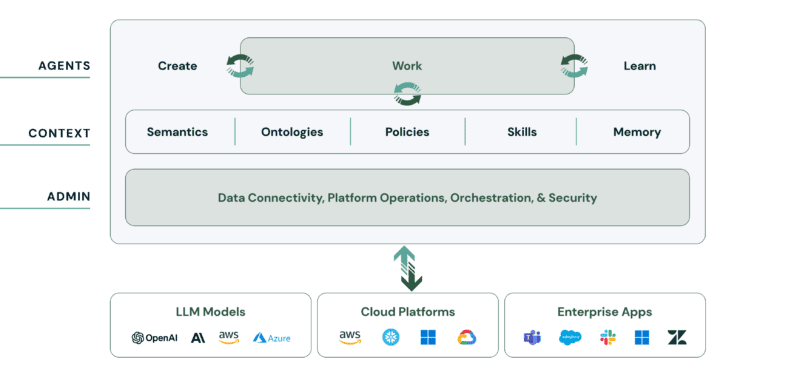
Build, configure, test, version, and publish agents in a collaborative web environment. Teams use natural-language runbooks to define how agents work, connect the right data sources, AI models, and tools through configuration profiles, and test changes with immediate feedback. Version history makes it easy to compare releases, test new approaches, and roll back with confidence.
Give agents access to the information they need to make useful, informed decisions. Sema4.ai combines document intelligence, semantic data models, Data Collections, business ontology, and DataFrames to help agents understand enterprise documents, data, relationships, terminology, and rules. The result is AI work grounded in the organization’s actual knowledge—not generic responses.
Agents must be able to do more than retrieve information. Through managed MCP connectivity, custom servers, secure email integrations, verified queries, and a secure code-execution environment, Sema4.ai enables agents to analyze data, trigger workflows, update systems, generate files, and complete multi-step business tasks. Teams can extend agent capabilities while maintaining control over credentials, permissions, and approved actions.
Agents can respond to business events immediately, such as incoming emails, documents, application changes, or webhooks, and carry work through from intake to resolution. They can process documents, validate information, apply business rules, perform calculations, manage exceptions, and escalate to people when judgment is needed. Every work item is visible, traceable, and manageable throughout its lifecycle.
Work Room gives business users a purpose-built place to collaborate with conversational agents and supervise autonomous work. Users can ask questions, upload files, review agent outputs, monitor work items, and provide help when exceptions arise. This creates a transparent operating model in which people stay involved where their expertise matters most.
Sema4.ai is built for the requirements of production AI: role-based access, single sign-on, secure credentials, audit trails, controlled sharing, data lineage, and lifecycle management. Platform operations and integrations with established observability tools help teams monitor activity, manage change, and operate agents reliably across environments, while maintaining security boundaries aligned with your enterprise architecture.
Together, these capabilities make Sema4.ai more than an agent builder. It is a platform for transforming high-stakes, document- and data-intensive work into trusted AI workforces: agents that can reason, act, collaborate, and operate with the control enterprises require.
The transition from traditional automation to enterprise AI agents represents more than a technical shift; it’s a redefinition of how enterprises operate. Organizations that embrace this evolution position themselves to achieve significant competitive advantages through improved efficiency, reduced costs, and enhanced service quality.
The key to successful implementation lies in adopting structured approaches that address the unique challenges of enterprise AI deployment. Through proper governance, security measures, and deployment frameworks like SAFE, organizations can realize the full potential of intelligent automation while maintaining the control and oversight necessary for enterprise-grade operations.
As the enterprise AI landscape continues to evolve, organizations that invest in comprehensive agent orchestration platforms will be best positioned to adapt to changing requirements and capitalize on emerging opportunities. The future belongs to organizations that can effectively harness the power of autonomous, goal-driven AI agents to transform their business operations.
Ready to transform your enterprise operations with intelligent automation? Explore Sema4.ai’s SAFE approach to intelligent automation and discover how our comprehensive platform can help you build, deploy, and manage sophisticated AI agents that deliver measurable business results.

 Learn about Agent Studio